10 Costly Marketing Automation Mistakes and How to Fix Them
Avoid these 10 common marketing automation mistakes that waste budget and hurt conversions. Learn practical fixes to get your automation back on track.
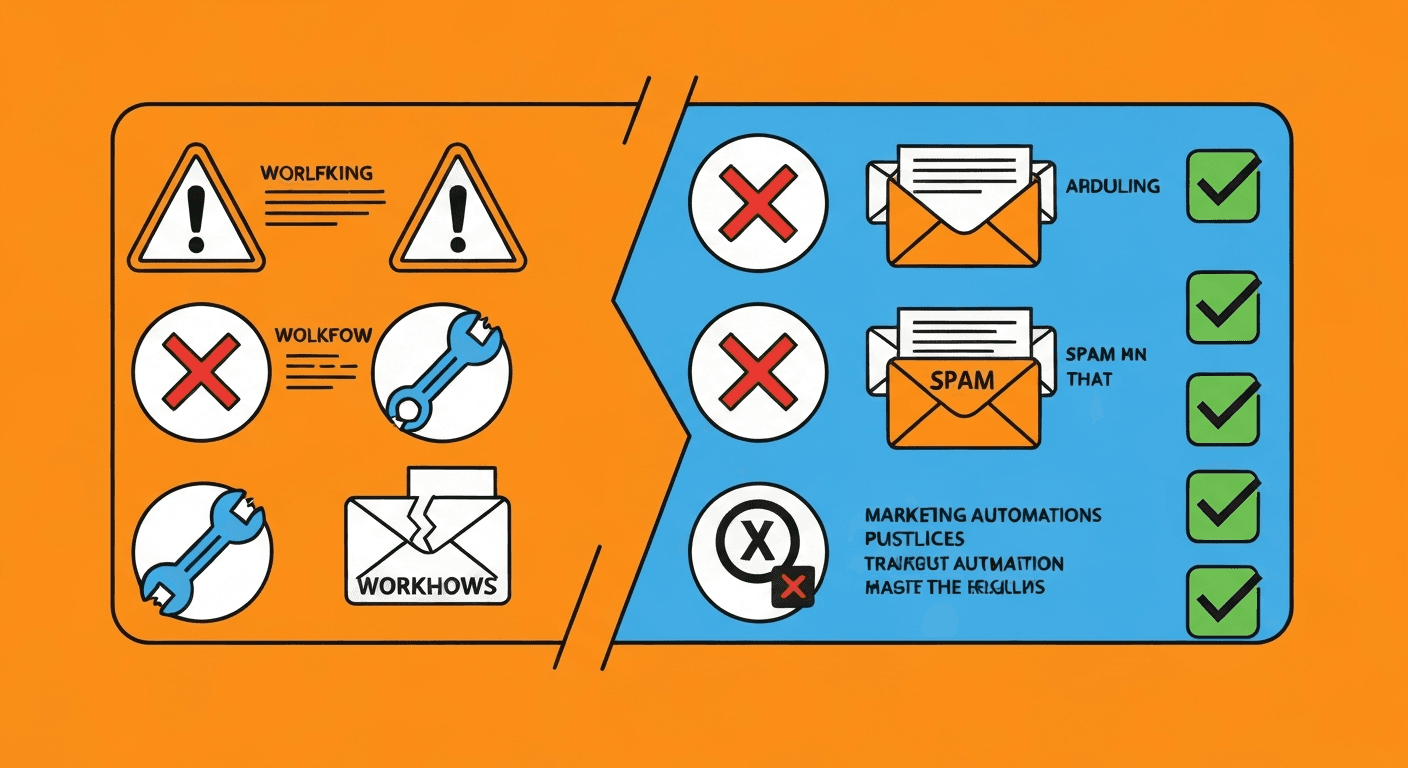
Marketing automation promises efficiency, scalability, and higher revenue. But those results only materialize when the system is built and managed correctly. Too many businesses invest in powerful automation platforms and then sabotage their own success with avoidable mistakes. The result is wasted budget, frustrated contacts, misaligned teams, and underwhelming performance that makes executives question the entire investment.
This guide identifies the ten most costly marketing automation mistakes and provides practical, actionable fixes for each one.
Mistake 1: How Does Automating Without a Strategy Hurt Your Results?
The most common and most damaging mistake is jumping straight into building workflows without defining a clear strategy first. Teams get excited about the technology, start creating automation rules, and end up with a disorganized collection of workflows that do not connect to meaningful business objectives.
What goes wrong: Random workflows fire without coordination. Contacts receive contradictory messages from different sequences. Nobody can explain what the automation system is actually trying to accomplish because there was never a defined plan.
How to fix it: Before building anything, document your automation strategy. Define the specific business goals each workflow will support, such as reducing lead response time, increasing trial-to-paid conversion, or improving customer retention. Map out the complete customer journey and identify the specific points where automation will add value. Then build workflows that directly serve those goals. If a workflow does not connect to a documented objective, it should not exist.
For a structured approach to building purposeful workflows, read our marketing automation workflows guide.
Mistake 2: Why Does Poor Data Quality Destroy Automation Performance?
Data quality is the foundation that everything else sits on. If your contact records are incomplete, outdated, duplicated, or inaccurate, every automated action built on that data will underperform.
What goes wrong: Emails go to invalid addresses, tanking your deliverability. Personalization fields display incorrectly because names or company information are missing or wrong. Segmentation puts contacts in the wrong groups. Lead scores are calculated on bad data, sending unqualified leads to sales and burying real opportunities.
How to fix it: Implement a data quality program that includes automated validation at the point of entry, regular deduplication sweeps, periodic enrichment using third-party data providers, and standardization rules for fields like job titles, company names, and phone numbers. Schedule a monthly data health audit that checks for completeness, accuracy, and consistency. Treat data quality as an ongoing discipline, not a one-time cleanup project.
Mistake 3: How Does Over-Segmentation Complicate Your Automation?
Segmentation is essential for relevance, but there is a tipping point where too many segments create more problems than they solve. Over-segmentation leads to an unmanageable number of workflows, content variations, and rules that no one on your team can keep track of.
What goes wrong: Your team spends more time managing segments than creating valuable content. Small segments do not have enough volume to generate statistically meaningful test results. Contacts fall through the cracks because they do not fit neatly into any of your hyper-specific categories.
How to fix it: Start with a manageable number of segments based on the criteria that have the biggest impact on engagement and conversion. For most B2B organizations, segmenting by industry, company size, role, and buying stage is sufficient to deliver relevant messaging. For B2C, consider segmenting by purchase behavior, engagement level, and lifecycle stage. You can always add more granularity later as you have data to justify it. The goal is segments large enough to be actionable and distinct enough to warrant different messaging.
Mistake 4: Why Is Set-It-and-Forget-It the Worst Approach to Automation?
Many businesses treat automation as a one-time implementation project. They build their workflows, turn them on, and move on to other priorities. Months later, those workflows are still running the same messaging to a changed audience in a changed market.
What goes wrong: Content becomes outdated. Links break. Offers expire but emails keep promoting them. Performance gradually declines, but nobody notices because nobody is monitoring the dashboards. Contacts receive stale, irrelevant content that damages your brand perception.
How to fix it: Assign clear ownership for every active workflow. Establish a regular review cadence, at minimum monthly for high-volume workflows and quarterly for all others. During each review, check for:
- Broken links or expired offers
- Declining engagement metrics (open rates, click rates, conversion rates)
- Content that references outdated information (statistics, product features, pricing)
- Opportunities to A/B test new variations
- Changes in audience behavior or market conditions that require adjustments
Automation is not autopilot. It still needs a pilot.
Mistake 5: How Does Ignoring the Customer Journey Lead to Irrelevant Messaging?
Building automation around your internal processes instead of the customer's experience is a recipe for disconnected, irrelevant communication. When workflows are designed based on what is convenient for your team rather than what is valuable for the prospect, the result is messaging that feels tone-deaf.
What goes wrong: A prospect who just downloaded an introductory guide immediately receives a hard-sell email asking them to buy. A new customer who completed onboarding keeps getting onboarding emails. A long-time customer gets treated like a stranger because the automation does not account for their history.
How to fix it: Map the complete customer journey from first awareness through purchase and post-sale engagement. Identify the questions, concerns, and needs prospects have at each stage. Build automation workflows that align with those stages and include logic to move contacts between stages based on their behavior. Use exit conditions to prevent contacts from receiving irrelevant messages and entry conditions to ensure they qualify for each sequence they enter.
Understanding the fundamentals of this approach starts with knowing what marketing automation is and how it fits into the broader customer experience.
Mistake 6: Why Does Neglecting Lead Scoring Waste Sales Resources?
Without lead scoring, your automation system treats every lead equally. That means your sales team receives a firehose of contacts with no way to prioritize who to call first, resulting in wasted time on unqualified prospects and missed opportunities with high-intent buyers.
What goes wrong: Sales reps spend hours chasing leads who downloaded a single blog post six months ago. Meanwhile, a prospect who visited the pricing page three times this week and opened every email in your nurture sequence sits untouched in the queue.
How to fix it: Implement an automated lead scoring system that assigns points based on both demographic fit and behavioral engagement. Work with your sales team to define what constitutes a qualified lead and set score thresholds that trigger handoff to sales. Review and recalibrate your scoring model quarterly based on actual conversion data. The goal is to ensure that every lead passed to sales has a meaningful probability of converting.
Mistake 7: How Does Sending Too Many Emails Damage Your Brand?
Email fatigue is real, and it is one of the fastest ways to destroy subscriber engagement and your sender reputation. When contacts receive too many emails, they stop opening them, mark them as spam, or unsubscribe entirely.
What goes wrong: Multiple workflows fire simultaneously, sending three emails in a single day to the same contact. Subscribers feel bombarded and develop negative associations with your brand. Spam complaint rates rise, which triggers deliverability issues with email service providers. Your list shrinks as unsubscribes outpace new signups.
How to fix it: Implement frequency caps that limit the maximum number of emails any single contact can receive within a defined time period. Most automation platforms offer this feature. A reasonable starting point is no more than two to three marketing emails per week per contact, though the right cadence depends on your industry and audience expectations. Additionally, use a global suppression layer that prevents contacts from being enrolled in multiple active sequences simultaneously unless you intentionally designed them to work together.
Mistake 8: Why Does Skipping A/B Testing Leave Revenue on the Table?
Many automation programs launch workflows with a single version of every email, landing page, and call to action, and never test alternatives. This means you are almost certainly leaving significant performance gains untapped.
What goes wrong: Subject lines that could perform 30 percent better never get tested. Landing page layouts that could double conversion rates never get compared against the original. Without testing, you have no data to inform improvements, so optimization is based on gut feeling instead of evidence.
How to fix it: Build A/B testing into every significant workflow from day one. Prioritize tests based on potential impact:
- Email subject lines (highest leverage for open rates)
- Call-to-action text and design (highest leverage for click-through rates)
- Landing page headlines and layouts (highest leverage for conversion rates)
- Email send times (can meaningfully affect engagement)
- Content format and length (different audiences prefer different approaches)
Run each test long enough to reach statistical significance before declaring a winner. Document your results and apply learnings across all workflows, not just the one you tested.
Mistake 9: How Does Failing to Integrate Your CRM Create Data Silos?
Marketing automation that operates in isolation from your CRM and other business systems creates dangerous data silos. Marketing has one view of the customer. Sales has another. Support has a third. Nobody has the complete picture.
What goes wrong: Sales reps reach out to prospects unaware of recent marketing interactions. Marketing sends acquisition campaigns to existing customers. Lead scores do not reflect sales activity. Attribution is impossible because data lives in disconnected systems.
How to fix it: Prioritize a robust CRM integration from the start. Ensure that contact records, activity data, deal stages, and engagement metrics sync bidirectionally between your automation platform and CRM. Define clear data ownership rules, such as marketing owns engagement data and sales owns deal data, and establish integration monitoring to catch sync failures before they cause problems.
Mistake 10: How Does Ignoring Compliance Put Your Business at Risk?
Email marketing and automation are subject to regulations including CAN-SPAM, GDPR, CCPA, and other privacy laws. Ignoring these requirements does not just risk fines. It damages customer trust and can result in your sending domain being blacklisted.
What goes wrong: Contacts are added to marketing lists without proper consent. Unsubscribe requests are not honored promptly. Personal data is stored or processed in ways that violate privacy regulations. Marketing emails lack required elements like a physical mailing address and clear unsubscribe link.
How to fix it: Implement compliance as a foundational layer of your automation system, not an afterthought. Ensure that:
- Every contact has documented consent before receiving marketing communications.
- Unsubscribe mechanisms are present in every email and function immediately.
- Data retention policies are defined and enforced automatically.
- Privacy preferences are respected across all channels and workflows.
- Your team is trained on the specific regulations that apply to your business and audience.
Build compliance checks into your workflow review process so that every new automation is evaluated against regulatory requirements before it goes live.
How Do You Audit Your Current Automation for These Mistakes?
If you are already running marketing automation, conduct a systematic audit to identify which of these mistakes might be affecting your performance. Here is a practical audit framework.
Audit Step 1: Inventory All Active Workflows
Create a complete list of every automation, workflow, sequence, and rule currently active in your platform. For each one, document its purpose, the audience it targets, when it was last reviewed, and who owns it.
Audit Step 2: Check Data Quality
Run a data health report across your entire contact database. Look at completeness rates for key fields, the number of duplicate records, the percentage of invalid email addresses, and the age of records that have not been updated recently.
Audit Step 3: Review Contact Frequency
Analyze how many emails your most active contacts receive per week and per month. Identify contacts who are enrolled in multiple sequences simultaneously and check whether frequency caps are in place.
Audit Step 4: Evaluate Lead Scoring Accuracy
Pull a report of leads that were scored as qualified and compare against actual conversion outcomes. Calculate the accuracy rate and identify where the model over-scores or under-scores.
Audit Step 5: Verify Integration Health
Check that data is syncing correctly between your automation platform, CRM, and other connected systems. Look for sync errors, missing records, and fields that are not mapping correctly.
Audit Step 6: Confirm Compliance
Review your consent records, unsubscribe processes, email templates, and data handling practices against current regulatory requirements.
What Should You Do After Identifying Mistakes?
Prioritize fixes based on business impact. Data quality and compliance issues should be addressed immediately because they affect everything downstream. Lead scoring and CRM integration improvements should follow because they directly impact revenue. Optimization efforts like A/B testing and frequency management can be implemented incrementally.
Create a remediation roadmap with specific owners, deadlines, and success metrics for each fix. Track progress in regular marketing operations reviews and measure the impact of each improvement on your overall automation ROI.
Final Thoughts on Avoiding Marketing Automation Mistakes
Marketing automation is a powerful investment, but its potential can only be realized through thoughtful implementation and ongoing management. The ten mistakes outlined in this guide represent the most common reasons automation programs underperform. The good news is that every single one of them is fixable.
Start by auditing your current setup against this list. Identify your biggest gaps. Fix the foundational issues first, data quality, strategy alignment, and compliance, then move on to optimization and refinement. If you are earlier in your automation journey and want to build a strong foundation from the start, our guide to marketing automation for small businesses provides a practical roadmap for getting it right from day one.
Harry Harrison
Founder & Editor, Easy Automation
Tech-forward B2B writer and content strategist focused on marketing and finance automation.